
British · Beef
Corned Beef Hash
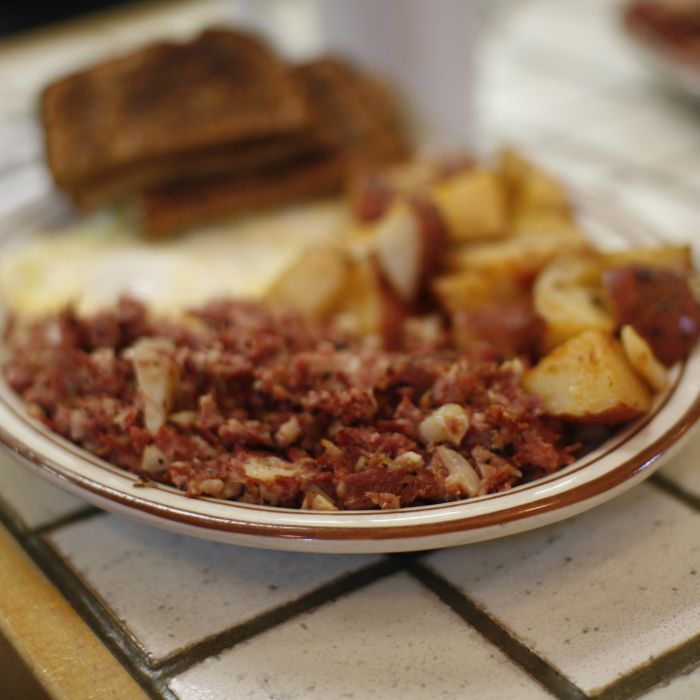
About this recipe
British cooking traditions favour generous root vegetables, slow-cooked meats, hearty puddings, and the kind of food that warms a damp island. The everyday repertoire prioritises preservation and shared family meals; the special-occasion repertoire (roast beef, Christmas pudding) is among the most globally recognised.
As a beef dish, Corned Beef Hash rewards matching the cut to the method — tender cuts for fast hot cooking, tougher cuts (chuck, brisket, shank) for slow braising where the collagen has time to surrender.
The scaler above rewrites every measurement to your target serving count, with proper culinary fractions (½, ⅓, ¼) instead of decimals so the recipe stays measurable. Cook Mode steps you through it hands-free.
Recipe data is sourced from TheMealDB's open community database; ScaleRecipe handles the curation, the scaling math, the editorial commentary, and the conversion utilities woven into each page.
Translate this recipe
Reading in English
Listen to this recipe
No matching voice on this device
Method
- Sauté the onions:
- Heat butter in a large skillet (preferably cast iron) on medium heat. Add the onion and cook a few minutes, until translucent.
- Add the potatoes and corned beef:
- Mix in the chopped corned beef and potatoes. Spread out evenly over the pan. Increase the heat to high or medium high and press down on the mixture with a metal spatula.
- Cook until browned and then flip:
- Do not stir the potatoes and corned beef, but let them brown. If you hear them sizzling, this is good.
- Use a metal spatula to peek underneath and see if they are browning. If nicely browned, use the spatula to flip sections over in the pan so that they brown on the other side. Press down again with the spatula.
- If there is too much sticking, you can add a little more butter to the pan. Continue to cook in this manner until the potatoes and the corned beef are nicely browned.
- Stir in the parsley and season:
- Remove from heat, stir in chopped parsley. Add plenty of freshly ground black pepper, and add salt to taste.
Cooking notes
When scaling protein-led dishes, weigh the meat rather than counting pieces, and remember that the pan size limits how much you can sear at once.
For volume-to-weight conversions of any ingredient — flour, sugar, butter, salts — use the ingredient converter. To translate the recipe's oven temperature between °C, °F and gas mark, see the temperature converter.
When you scale this recipe up or down, remember that cooking time does not scale linearly. A doubled cake takes longer, but not twice as long; a doubled soup takes roughly twice as long. The cooking-time guide gives sensible starting estimates by dish geometry.
Scaling notes
Scaling Corned Beef Hash
Corned Beef Hash is written for around four servings as it stands on this page — scaling it up for a party or down for a meal-for-one is the small math problem most home cooks face every week. Here's how this particular dish responds to scaling, what changes linearly, and what doesn't.
The trick with beef dishes like Corned Beef Hash is that braising time is set by collagen breakdown, not by total mass — a doubled batch takes essentially the same time as a single one. Seared or grilled beef scales by the piece, not the kilogram: budget the same per-portion sear time, and make sure your pan has space for every piece to sit in a single layer.
Butter is one of the easier ingredients to scale because it's sold in standardised sticks: 1 US stick = 8 tablespoons = ½ cup = 113 g. Any fractional scaling lines up neatly on a kitchen scale, and grocery-store butter packaging is already pre-marked in tablespoon increments along the wrapper.
Skip the math entirely — ScaleRecipe's scaler rewrites every ingredient line above with proper culinary fractions and smart unit promotion the moment you change the serving count. Open the scaler →
Beyond the recipe
Substitutions & make-ahead — Corned Beef Hash
Two things home cooks ask about most when they're outside the recipe's exact assumptions: what swaps work for which ingredients, and how the dish behaves when you make it ahead. Both depend on what Corned Beef Hash is doing structurally — here's the practical version.
Substitution ideas
Butter
For sautéing or browning, equal-weight olive oil or a neutral oil works directly. For baking, equal-weight coconut oil (melted, then chilled to the same softness the recipe expects) gives a buttery richness; a quality vegan butter brick is the structural match for cookies and pastries where firmness matters.
For weight-based swaps and arbitrary quantities, the ingredient density converter and the cup-to-grams chart cover most pantry staples.
Make-ahead and storage
Corned Beef Hash sits firmly in the braise-improves-overnight category if it's a braise or stew — collagen continues to soften, flavours marry, and the layer of fat that floats to the top is easier to skim cold. Cool the pot uncovered to room temperature before refrigerating in a wide shallow container; this keeps things food-safe and lets reheating finish in 15-20 minutes the next day. Seared steaks and ground-beef dishes go the other way — best fresh, because reheating overshoots medium and the crust on a steak doesn't survive.
Recipe video
Corned Beef Hash
Keep cooking
More beef recipes
Cooking aids
Tools to use while you cook this.
Each opens in a new tab so the timer keeps running. The math is auditable on the guide page below each converter, with worked examples and where the numbers come from.
Volume
Tablespoons, teaspoons, cups, ml, fluid ounces — every culinary volume unit, with US/metric/imperial cups handled distinctly.
OpenWeight
Grams, ounces, pounds, kilograms — exact for any ingredient, plus the volume-to-weight conversions for ~40 pantry staples.
OpenTemperature
Fahrenheit, Celsius, gas mark — translate any oven temperature, with notes on conventional vs convection.
OpenCooking time
The cube-root rule for scaling up, the differences between meat / cake / soup geometry, and sensible starting estimates.
OpenPan size
9-inch round vs 8-inch square vs 13×9. The math is surface area, not diameter — and the converter shows you both.
OpenLength
Inches and centimetres — for when a recipe says “cut into 1-inch pieces” and your ruler is metric.
OpenIngredient density
A cup of flour weighs 120 g; a cup of honey weighs 340. The full table of ~40 staples, with sources.
OpenOpen in main scaler
Edit the recipe text, scale by serving count, and copy the result. Same parser as the in-page scaler, more room to work.
OpenFrom the journal
Original essays on the small details.
The why behind the technique — original writing on the ingredient and equipment choices that separate a good cook from a frustrated one.
Reading a recipe like a chef
The 30-or-so recipe terms that show up most often, decoded
Read essayMay 4, 2026
Cooking for one — scaling principles
The math, the practical realities, and the recipes designed for one from the start
Read essayMay 4, 2026
How long do leftovers actually last?
Beyond the USDA's 3–4 days: the variables that actually determine the safe window
Read essayMay 4, 2026
Go deeper
Where this recipe sits in the wider tradition.
Each guide below is a real essay on the cuisine or the category — pillars, staples, techniques worth learning — paired with a curated grid of recipes filed under it.
Cuisine guide · British
Cooking the British way
A cuisine quietly remade — and much better than its reputation suggests.
Open the guideCategory guide · Beef
How to cook in this category
From the cheapest braising cut to the priciest steak — beef is a cuisine of its own.
Open the guideKeep exploring
Ready to cook?
Scale it to your table, then get into the kitchen.
Send this recipe to the main scaler for further editing, or jump straight into Cook Mode for a hands-free walk-through with timers running.