
Journal
Field notes from
a careful kitchen.
Topics covered
Latest · Technique
May 4, 2026
Reading a recipe like a chef
The 30-or-so recipe terms that show up most often, decoded
Recipes are written in a private language. 'Sweat the onions' isn't 'cook them sweaty'; 'reduce by half' isn't a heat instruction. A practical glossary of heat words, cuts, doneness signals, and seasoning verbs — once you can decode them, recipes become straightforward instructions.
Read the articleTechnique
7 articlesMay 4, 2026
Reading a recipe like a chef
The 30-or-so recipe terms that show up most often, decoded
Recipes are written in a private language. 'Sweat the onions' isn't 'cook them sweaty'; 'reduce by half' isn't a heat instruction. A practical glossary of heat words, cuts, doneness signals, and seasoning verbs — once you can decode them, recipes become straightforward instructions.
Read
May 4, 2026
Cooking for one — scaling principles
The math, the practical realities, and the recipes designed for one from the start
Most recipes are written for four. The three approaches solo cooks use — scaling down, cooking-and-freezing, and one-portion-from-the-start patterns — each fit different dishes. A guide to which approach works when, plus the single-serving sizes that match how solo cooks actually eat.
Read
May 4, 2026
How long do leftovers actually last?
Beyond the USDA's 3–4 days: the variables that actually determine the safe window
The 'leftovers last 3–4 days' rule covers every household, every fridge, every food. The actual safe window depends on cooling speed, acidity, doneness, and ingredient mix. A category-by-category guide, plus three habits that triple how long leftovers actually keep.
Read
May 4, 2026
The grocery store cuts you should know
The cheap cuts that punch above their price (and the expensive ones that don't)
Most home cooks rotate through eight or nine cuts of meat. The interesting ones — chuck, skirt, hanger, brisket, shank, pork shoulder, bone-in chicken thighs — are usually right there in the case, mislabelled or overlooked. A guide to the cheaper cuts that eat better, and the premium ones that aren't worth the markup.
Read
May 4, 2026
Substitution rules for missing ingredients
When swapping works, when it doesn't, and how to tell which case you're in
Every ingredient plays a structural role — flavour, leavening, structure, fat, acid. Substitutions only work when you replace the role correctly. The dairy, flour, egg, and herb swaps that actually work, and the recipes where pivoting beats substituting.
Read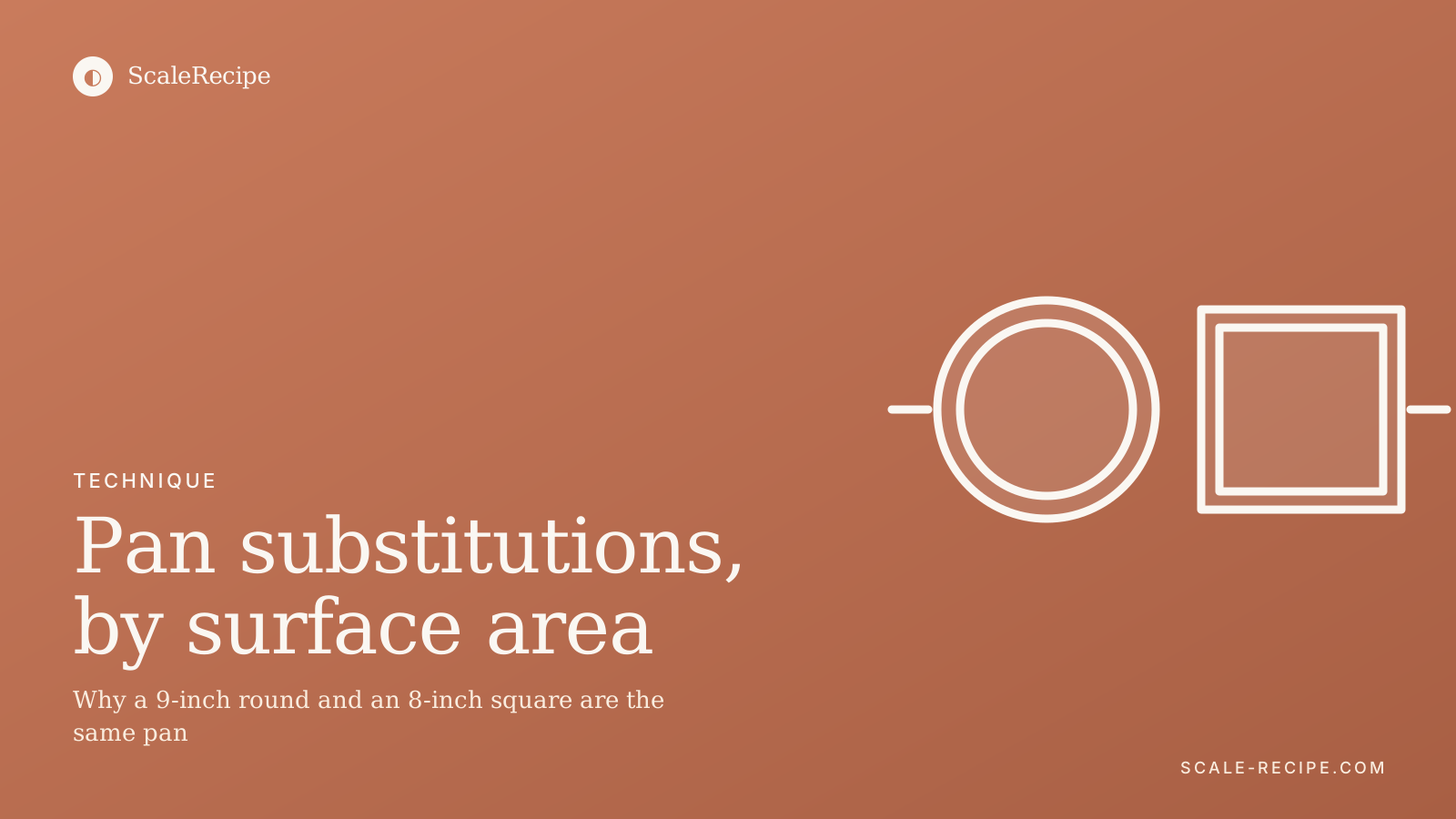
May 4, 2026
Pan substitutions, by surface area
Why a 9-inch round and an 8-inch square are the same pan
When the recipe says one pan and you have another, the right comparison isn't the diameter — it's the surface area. A 9-inch round and an 8-inch square are within 1 % of each other. A 9-inch round and a 9-inch square are 25 % apart.
Read
May 4, 2026
Why doubling a cake doesn't double the bake
The cube-root rule, and the geometry of how heat actually moves
Scaling a recipe doubles the ingredients but rarely doubles the cooking time. The reason is geometric — heat reaches the centre of a thicker cake more slowly — and the right rule depends on what you're cooking.
Read
Equipment
4 articles
May 4, 2026
Knife maintenance, simply
Two tools, three minutes a week, ten minutes every two months — done
A sharp knife is the difference between cooking being fun and being a chore. Knife maintenance has been mystified by snobs; the actual minimum routine is two tools and a few minutes a week. The honing rod, the sharpener, the three habits that ruin knives, and the lifetime kit that costs $200–350.
Read
May 4, 2026
Weighing salt: a kitchen scale playbook
The single piece of kitchen kit that ends the salt-brand wars
A kitchen scale costs less than a decent pan and solves more problems than any other piece of kit. The four habits that turn weighing from 'extra step' into reflex, what features actually matter, and why salt is the worst ingredient to measure by volume.
Read
May 4, 2026
Pantry essentials for a serious cook
The thirty items that compound into hundreds of meals
A useful pantry isn't wide and shallow — it's thirty items used weekly, kept fresh, restocked when half-empty. The salt-and-acid line, the fat triumvirate, the umami shelf, and the six-spice base that handles 95 % of weeknight cooking.
Read
May 4, 2026
The case for the oven thermometer
Your oven is probably lying to you, and here's how to catch it
Domestic ovens drift, ~10–25 °F off true on average and worse with age. A $10 thermometer is the highest-leverage piece of kitchen kit you can buy — better cookies, fewer ruined roasts, and the end of guessing why a recipe didn't work.
Read
Baking
4 articles
May 4, 2026
Why your bread doesn't rise
Seven well-understood failure modes, in diagnostic order
Bread failure has only a handful of causes — and the most common one (dead yeast) is the one home bakers diagnose last. The 5-minute foam test that prevents 80 % of failures, why water temperature matters, when over-proofing collapses your dough, and how to walk the diagnostic list in order.
Read
May 4, 2026
Eggs by weight, not by count
Why your four-egg recipe might really be a five-egg recipe
A 'large' egg can weigh 49 g or 56 g — a 14 % spread that turns a four-egg cake into a five-egg cake without you noticing. Here's why bakers weigh eggs and what to do when your carton has the wrong size.
Read
May 4, 2026
Butter temperature ruins more cookies than the oven does
Cold, softened, melted — three states, three completely different bakes
Most cookie recipes specify 'softened' butter and most cooks read that as 'whatever's on the counter'. The actual temperature window is narrow — 65 to 67 °F — and being on the wrong side of it is the single biggest cause of bad cookies.
Read
May 4, 2026
Your flour is heavier than the recipe thinks
Why volume measurements lie about flour, and what to do about it
A cup of flour can weigh 113 g or 150 g depending on how you scooped it — a thirty-percent swing that destroys cookie texture. Here's the physics behind it and the simple fix every baker eventually adopts.
Read
Seasoning
2 articles
May 4, 2026
The salt brand problem
Why a tablespoon of one salt is half the salt of another, and how to convert safely
Diamond Crystal kosher salt weighs roughly half what table salt weighs by volume. Most recipes don't say which they assume. Here's how to read between the lines and make the swap without ruining dinner.
Read
May 4, 2026
The dried-herb conversion most cooks get wrong
The 3:1 rule isn't really a rule — and bay leaf, rosemary, and basil prove it
The standard fresh-to-dried herb ratio is 3:1 — but that's an average across plants that behave nothing alike. Rosemary holds its potency, basil loses it entirely, and parsley shouldn't be dried at all. Here's the herb-by-herb truth.
Read
By date
Every article, most recent first.
If you came here looking for the latest, this is the chronological view. Each entry links straight to the article.
Reading a recipe like a chef
The 30-or-so recipe terms that show up most often, decoded
Technique · May 4, 2026
Cooking for one — scaling principles
The math, the practical realities, and the recipes designed for one from the start
Technique · May 4, 2026
How long do leftovers actually last?
Beyond the USDA's 3–4 days: the variables that actually determine the safe window
Technique · May 4, 2026
Knife maintenance, simply
Two tools, three minutes a week, ten minutes every two months — done
Equipment · May 4, 2026
The grocery store cuts you should know
The cheap cuts that punch above their price (and the expensive ones that don't)
Technique · May 4, 2026
Why your bread doesn't rise
Seven well-understood failure modes, in diagnostic order
Baking · May 4, 2026
Weighing salt: a kitchen scale playbook
The single piece of kitchen kit that ends the salt-brand wars
Equipment · May 4, 2026
Pantry essentials for a serious cook
The thirty items that compound into hundreds of meals
Equipment · May 4, 2026
Substitution rules for missing ingredients
When swapping works, when it doesn't, and how to tell which case you're in
Technique · May 4, 2026
Eggs by weight, not by count
Why your four-egg recipe might really be a five-egg recipe
Baking · May 4, 2026
The case for the oven thermometer
Your oven is probably lying to you, and here's how to catch it
Equipment · May 4, 2026
Butter temperature ruins more cookies than the oven does
Cold, softened, melted — three states, three completely different bakes
Baking · May 4, 2026
Pan substitutions, by surface area
Why a 9-inch round and an 8-inch square are the same pan
Technique · May 4, 2026
Your flour is heavier than the recipe thinks
Why volume measurements lie about flour, and what to do about it
Baking · May 4, 2026
The salt brand problem
Why a tablespoon of one salt is half the salt of another, and how to convert safely
Seasoning · May 4, 2026
Why doubling a cake doesn't double the bake
The cube-root rule, and the geometry of how heat actually moves
Technique · May 4, 2026
The dried-herb conversion most cooks get wrong
The 3:1 rule isn't really a rule — and bay leaf, rosemary, and basil prove it
Seasoning · May 4, 2026
What we write about
The details a converter alone can't solve.
The journal exists for the questions a calculator can't answer. The ingredient converter tells you that a cup of flour weighs 120 g; the journal tells you why your cup might actually weigh 150 g and what to do about it. The temperature converter tells you that 350 °F is 180 °C; the journal tells you why your oven might actually be running 325 °F when the dial says 350 °F.
Each piece sticks to a single small thing — flour density, salt brand variation, butter temperature, oven calibration, herb drying — and tries to be honest about it. No round-up posts. No life-hack listicles. No padding to hit a word count. Just one calibrated answer at a time.
What you won't find here
No newsletter. No RSS push notifications. No comment threads to moderate. We post when we have something worth saying — usually once a month, sometimes less. The journal is intended to be bookmarkable rather than algorithmic.
Where to start
The two pieces most cooks find immediately useful are Your flour is heavier than the recipe thinks and The salt brand problem — they cover the two ingredients responsible for most quietly-failing recipes. After that, The case for the oven thermometer and Butter temperature ruins more cookies than the oven does cover the two pieces of equipment most home kitchens get wrong.
Where the journal fits
Read once, refer to often.
The articles are companion pieces to the interactive tools. Read them once to understand the why; come back to the converters and scaler when you need a number.
The scaler
Scale a recipe
Paste any recipe — text or URL — and the scaler rewrites quantities with proper culinary fractions. The journal explains why the rounding is calibrated the way it is.
Open the scalerThe toolkit
Seven converters
Volume, weight, temperature, length, pan size, cooking time, ingredient density. Each pairs with a journal article that explains the tool's edge cases and when it stops being right.
See all convertersThe chart
Quick reference
Fourteen at-a-glance reference cards for mid-recipe lookup, plus eight calibrated ingredient substitutions. Hands-floury cookbook on a single page.
Open quick referenceAbout the journal
Asked. Answered.
The questions readers send most often about the journal — how often we publish, who writes, what we'll cover next.
Site-wide FAQHow often do new articles come out?
Roughly monthly. We post when there's a single small thing worth saying carefully, not on a fixed schedule. There's no newsletter and no RSS push — bookmark the page or check back when the kettle's on.
Who writes the articles?
ScaleRecipe is built and edited by Muhammad Salman Saleem, a developer who got tired of recipes failing for non-recipe reasons. Every article is written from a working kitchen.
Can I suggest a topic?
Yes — use the contact page. The best suggestions describe a specific failure mode you've hit (e.g. 'why does my pizza dough rise unevenly?') rather than asking for general coverage of a topic.
What's the editorial bias?
Calibrated, observed, slightly skeptical. We trust King Arthur Baking on flour density, USDA on egg weights, and almost no one on the internet about ‘the perfect ratio’ of anything. We don't repeat conventional wisdom unless it survives a kitchen test.
Keep reading
Or open the toolkit and put what you've read to use.
Every journal article links to the converters and recipes the article touches on, so you can move from understanding to doing without backtracking.