
United States · Breakfast
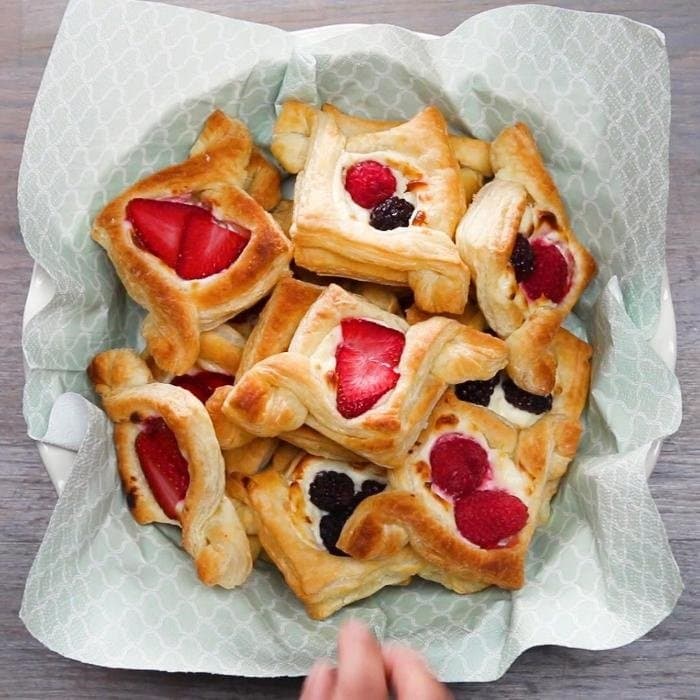
Fruit and Cream Cheese Breakfast Pastries
Translate this recipe
Reading in English
Listen to this recipe
No matching voice on this device
Method
- Preheat oven to 400ºF (200ºC), and prepare two cookie sheets with parchment paper. In a bowl, mix cream cheese, sugar, and vanilla until fully combined. Lightly flour the surface and roll out puff pastry on top to flatten. Cut each sheet of puff pastry into 9 equal squares. On the top right and bottom left of the pastry, cut an L shape approximately ½ inch (1 cm) from the edge.
- NOTE: This L shape should reach all the way down and across the square, however both L shapes should not meet at the ends. Your pastry should look like a picture frame with two corners still intact.
- Take the upper right corner and fold down towards the inner bottom corner. You will now have a diamond shape.
- Place 1 to 2 teaspoons of the cream cheese filling in the middle, then place berries on top.
- Repeat with the remaining pastry squares and place them onto the parchment covered baking sheet.
- Bake for 15-20 minutes or until pastry is golden brown and puffed.
- Enjoy!
Cooking notes
Scaling works best when you weigh ingredients rather than measure by volume — small differences in packing can compound at higher multipliers.
For volume-to-weight conversions of any ingredient — flour, sugar, butter, salts — use the ingredient converter. To translate the recipe's oven temperature between °C, °F and gas mark, see the temperature converter.
When you scale this recipe up or down, remember that cooking time does not scale linearly. A doubled cake takes longer, but not twice as long; a doubled soup takes roughly twice as long. The cooking-time guide gives sensible starting estimates by dish geometry.
Cooking aids
Tools to use while you cook this.
Each opens in a new tab so the timer keeps running. The math is auditable on the guide page below each converter, with worked examples and where the numbers come from.
Volume
Tablespoons, teaspoons, cups, ml, fluid ounces — every culinary volume unit, with US/metric/imperial cups handled distinctly.
OpenWeight
Grams, ounces, pounds, kilograms — exact for any ingredient, plus the volume-to-weight conversions for ~40 pantry staples.
OpenTemperature
Fahrenheit, Celsius, gas mark — translate any oven temperature, with notes on conventional vs convection.
OpenCooking time
The cube-root rule for scaling up, the differences between meat / cake / soup geometry, and sensible starting estimates.
OpenPan size
9-inch round vs 8-inch square vs 13×9. The math is surface area, not diameter — and the converter shows you both.
OpenLength
Inches and centimetres — for when a recipe says “cut into 1-inch pieces” and your ruler is metric.
OpenIngredient density
A cup of flour weighs 120 g; a cup of honey weighs 340. The full table of ~40 staples, with sources.
OpenOpen in main scaler
Edit the recipe text, scale by serving count, and copy the result. Same parser as the in-page scaler, more room to work.
OpenFrom the journal
Original essays on the small details.
The why behind the technique — original writing on the ingredient and equipment choices that separate a good cook from a frustrated one.
Eggs by weight, not by count
Why your four-egg recipe might really be a five-egg recipe
Read essayApril 12, 2026
The case for the oven thermometer
Your oven is probably lying to you, and here's how to catch it
Read essayFebruary 28, 2026
Butter temperature ruins more cookies than the oven does
Cold, softened, melted — three states, three completely different bakes
Read essayDecember 15, 2025
Ready to cook?
Scale it to your table, then get into the kitchen.
Send this recipe to the main scaler for further editing, or jump straight into Cook Mode for a hands-free walk-through with timers running.