
Canadian · Dessert
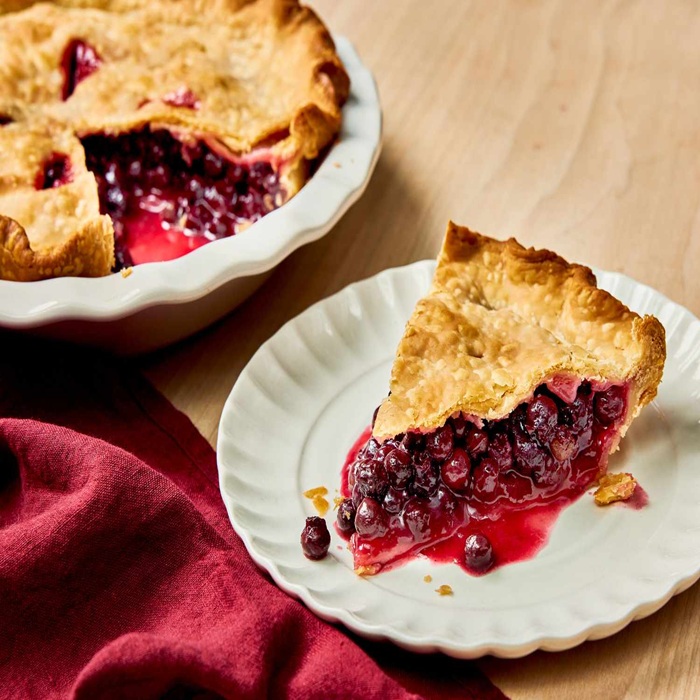
Saskatoon Pie
About this recipe
Canadian home cooking reflects regional traditions across a huge geography — Quebec's French legacy (tourtière, poutine), the British baking of the Maritimes, the Indigenous and Asian-influenced cuisines of the West Coast.
As a dessert, Saskatoon Pie is the part of cooking where ratio precision matters most: a five-percent miss on flour or sugar changes the texture in a way no savoury dish would notice. Weighing in grams beats measuring in cups every time.
Use the scaler above to set the number of servings you actually want to cook — quantities resize with culinary fractions, units promote sensibly (three teaspoons become a tablespoon), and the result reads like the recipe was written for your table.
Recipe data is sourced from TheMealDB's open community database; ScaleRecipe handles the curation, the scaling math, the editorial commentary, and the conversion utilities woven into each page.
Translate this recipe
Reading in English
Listen to this recipe
No matching voice on this device
Method
- To make the pastry, place the flour and salt in a large bowl. Mix well. Add the cubes of butter and shortening and mix them in (I like to use my hands to mix the fat into the flour, but you can use a pastry blender) just until it looks like coarse oatmeal with some pea-sized bits remaining. Place the egg in a 2-cup measure and beat it with a fork. Beat in the vinegar and just enough ice-cold water to bring it to the 1-cup mark. Stir this into the flour mixture, just until the dough clings together. I like to use my hands for this part as well, but a wooden spoon would also work. Try not to overmix it.
- On a lightly floured surface, gather the dough into a ball and divide it into 5 evenly sized portions. Shape each portion into a disc and wrap tightly in plastic. Chill 2 of these discs for 1 hour. Freeze the other 3 in a resealable freezer bag for future use. The pastry keeps well in the freezer for up to 2 months.
- Preheat the oven to 350°F. Place the rack in the lower third of the oven. Line a baking sheet with aluminum foil to catch drippings.
- On a lightly floured surface, roll out 1 disc of pastry into a 12-inch circle, or thereabouts. Place it in the bottom of a 9-inch pie plate, with the pastry overhanging the edges of the pie plate.
- To make the filling, place the saskatoon berries in a large bowl and stir in the 1/2 cup sugar and the cornstarch until well combined. Pour the berry mixture into the bottom of the pie. Dot with the butter. On a lightly floured surface, roll out the pastry in another 12-inch circle for the top crust. Use a ruler to guide you when cutting the pastry into 6 wide, long strips to keep the edges straight. Save the 2 end pieces in case you need to do any patching. I like wide strips, but if you like a thinner look, feel free to cut thin strips of pastry. Weave the pastry strips, going over and under, making sure they connect with the edges of the pie crust. Fold over the edges of the bottom crust, tucking in the lattice ends. This will help to trap the juices and give a rustic look.
- If you prefer a cleaner, tidier look, you can trim the overhanging pieces and crimp the edges with a fork. Brush the top of the pie with the egg wash. Sprinkle with the remaining Tbsp sugar. Place the pie on the prepared baking sheet and bake it for about 90 – 100 minutes, until it’s golden brown and bubbling. Remove the pie from the oven and place it on a wire rack to cool.
- Serve the pie warm or at room temperature with whipped cream or ice cream. Makes 6 servings. This keeps well if covered with plastic and refrigerated for up to 4 days.
Cooking notes
Baked goods are unforgiving with rounding — use weights rather than volumes whenever possible, and verify pan capacity if you scale up or down significantly.
For volume-to-weight conversions of any ingredient — flour, sugar, butter, salts — use the ingredient converter. To translate the recipe's oven temperature between °C, °F and gas mark, see the temperature converter.
When you scale this recipe up or down, remember that cooking time does not scale linearly. A doubled cake takes longer, but not twice as long; a doubled soup takes roughly twice as long. The cooking-time guide gives sensible starting estimates by dish geometry.
Scaling notes
Scaling Saskatoon Pie
Saskatoon Pie is written for around four servings as it stands on this page — scaling it up for a party or down for a meal-for-one is the small math problem most home cooks face every week. Here's how this particular dish responds to scaling, what changes linearly, and what doesn't.
Desserts are the most scaling-sensitive category, and Saskatoon Pie is no exception — the leavening, fat, and liquid ratios all interact. Doubling means a doubled pan AREA (not diameter), and bake time scales by the cube root of the volume change: a doubled cake takes about 26 % longer, not 100 %. Weigh ingredients in grams rather than measuring in cups for consistent results.
This recipe calls for eggs, which are the trickiest ingredient to scale to non-integer multiples. A US "large" egg weighs about 50 g; if a fractional scaling lands on, say, 1.5 eggs, beat one egg and weigh 25 g of the beaten mixture rather than guessing. The same goes for halving recipes — half an egg is 25 g of beaten egg, not a dramatic estimate.
Because this recipe is built around flour and sugar, weighing in grams (rather than measuring cups) is what separates a consistent bake from a one-time win. A cup of all-purpose flour can weigh 113 g or 150 g depending on how you scoop — that's a 30 % swing that ruins texture.
Skip the math entirely — ScaleRecipe's scaler rewrites every ingredient line above with proper culinary fractions and smart unit promotion the moment you change the serving count. Open the scaler →
Beyond the recipe
Substitutions & make-ahead — Saskatoon Pie
Two things home cooks ask about most when they're outside the recipe's exact assumptions: what swaps work for which ingredients, and how the dish behaves when you make it ahead. Both depend on what Saskatoon Pie is doing structurally — here's the practical version.
Substitution ideas
Eggs
For binding (cookies, quick breads, meatballs): 1 large egg ≈ 1 tbsp ground flaxseed + 3 tbsp water, rested 5 minutes until gelled — structurally closest to a real egg. For moisture without structure (cakes, brownies): ¼ cup unsweetened applesauce or mashed banana per egg, accepting some loss of rise.
Butter
For sautéing or browning, equal-weight olive oil or a neutral oil works directly. For baking, equal-weight coconut oil (melted, then chilled to the same softness the recipe expects) gives a buttery richness; a quality vegan butter brick is the structural match for cookies and pastries where firmness matters.
All-purpose flour
For gluten-free, a 1-to-1 gluten-free baking blend (one that contains xanthan gum) is the most reliable swap. For texture variations: bread flour gives chewier results; cake flour gives more tender. Avoid almond or oat flour as a 1:1 swap — they don't form gluten and most recipes structurally depend on it.
For weight-based swaps and arbitrary quantities, the ingredient density converter and the cup-to-grams chart cover most pantry staples.
Make-ahead and storage
Most desserts in Saskatoon Pie's family can be made one day ahead, but storage matters more than for savoury dishes. Cakes and breads go in an airtight container at room temperature — refrigeration stales them faster than room air. Custards, cream-based fillings, and any dessert with eggs as a structural ingredient must refrigerate. For freezer storage, unfrosted cake layers wrap tightly and keep 2 months; frosted versions ice-crystal within 3-4 weeks.
Recipe video
Saskatoon Pie
Keep cooking
More dessert recipes

Cooking aids
Tools to use while you cook this.
Each opens in a new tab so the timer keeps running. The math is auditable on the guide page below each converter, with worked examples and where the numbers come from.
Volume
Tablespoons, teaspoons, cups, ml, fluid ounces — every culinary volume unit, with US/metric/imperial cups handled distinctly.
OpenWeight
Grams, ounces, pounds, kilograms — exact for any ingredient, plus the volume-to-weight conversions for ~40 pantry staples.
OpenTemperature
Fahrenheit, Celsius, gas mark — translate any oven temperature, with notes on conventional vs convection.
OpenCooking time
The cube-root rule for scaling up, the differences between meat / cake / soup geometry, and sensible starting estimates.
OpenPan size
9-inch round vs 8-inch square vs 13×9. The math is surface area, not diameter — and the converter shows you both.
OpenLength
Inches and centimetres — for when a recipe says “cut into 1-inch pieces” and your ruler is metric.
OpenIngredient density
A cup of flour weighs 120 g; a cup of honey weighs 340. The full table of ~40 staples, with sources.
OpenOpen in main scaler
Edit the recipe text, scale by serving count, and copy the result. Same parser as the in-page scaler, more room to work.
OpenFrom the journal
Original essays on the small details.
The why behind the technique — original writing on the ingredient and equipment choices that separate a good cook from a frustrated one.
Reading a recipe like a chef
The 30-or-so recipe terms that show up most often, decoded
Read essayMay 4, 2026
Cooking for one — scaling principles
The math, the practical realities, and the recipes designed for one from the start
Read essayMay 4, 2026
How long do leftovers actually last?
Beyond the USDA's 3–4 days: the variables that actually determine the safe window
Read essayMay 4, 2026
Go deeper
Where this recipe sits in the wider tradition.
Each guide below is a real essay on the cuisine or the category — pillars, staples, techniques worth learning — paired with a curated grid of recipes filed under it.
Keep exploring
Ready to cook?
Scale it to your table, then get into the kitchen.
Send this recipe to the main scaler for further editing, or jump straight into Cook Mode for a hands-free walk-through with timers running.